
Patta Chitta, EC Explained for Chennai Property Buyers
Buying property in Chennai is a big milestone-but it can also feel confusing when you hear terms like Patta Chitta, EC" (Encumbrance Certificate). These documents are not just paperwork; they are critical legal proofs that protect your money and ownership rights.
Venshan
12/22/20253 min read
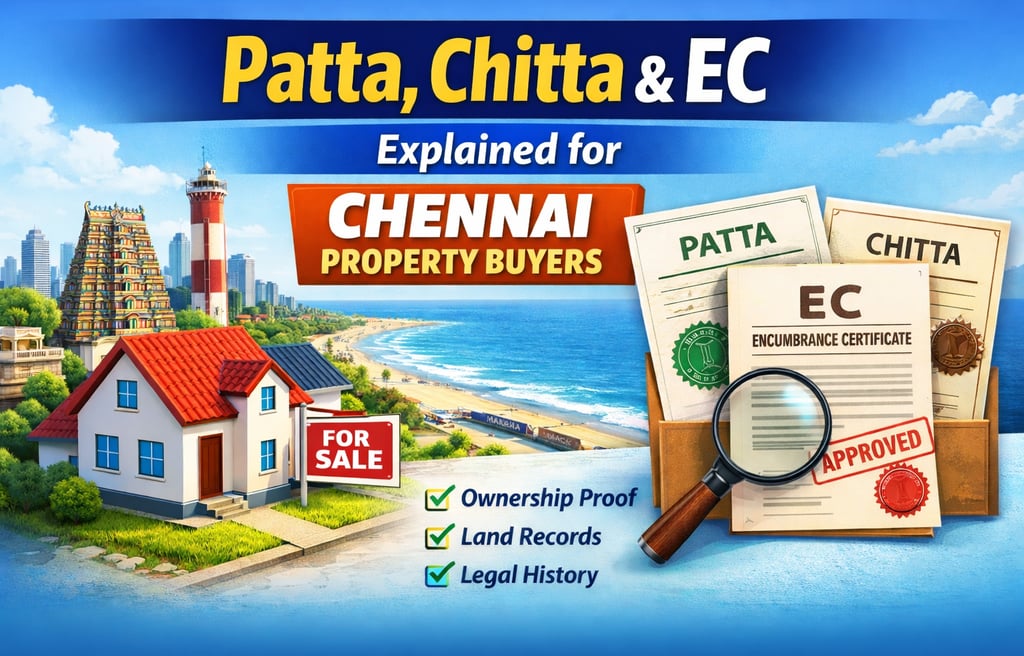
Buying property in Chennai is a big milestone-but it can also feel confusing when you hear terms like Patta, Chitta, and EC (Encumbrance Certificate). These documents are not just paperwork; they are critical legal proofs that protect your money and ownership rights.
If you are planning to buy a plot, house, or apartment in Chennai or anywhere in Tamil Nadu, this guide will explain everything in simple language for a general audience, without legal jargon.
Why These Documents Matter in Chennai
Chennai’s real estate market includes:
Approved & unapproved plots
Old ancestral properties
Joint patta lands
Layouts approved by CMDA / DTCP
Without verifying Patta, Chitta, and EC, buyers often face:
Registration issues
Bank loan rejection
Legal disputes
Government acquisition risks
👉 That’s why understanding these documents is non-negotiable.
What Is Patta? (Most Important Ownership Proof)
Meaning of Patta
A Patta is a government-issued land ownership record maintained by the Tamil Nadu Revenue Department.
It proves:
Who owns the land
Where the land is located
How much land is owned
Think of Patta as the identity card of the land.
Details Mentioned in a Patta
A Patta usually contains:
Owner’s name
Patta number
Survey number
Sub-division number
Land area
Village, Taluk, District
Land classification (wet / dry / residential)
Types of Patta in Chennai
1. Individual Patta
Issued to a single owner
Best and safest for buyers
2. Joint Patta
Multiple owners listed
Common in ancestral properties
3. Patta for Plots
Issued only if land is properly subdivided and approved
Is Patta Mandatory for Property Registration in Chennai?
✅ Yes, in most cases.
Sub-Registrar may allow registration without Patta
BUT banks, buyers, and courts will insist on it later
👉 Always buy property only with Patta in seller’s name.
What Is Chitta? (Land Classification Record)
Meaning of Chitta
A Chitta is a land record that shows:
Whether the land is Wet (Nanjai) or Dry (Punjai)
Earlier, Chitta was issued separately.
Now, Patta + Chitta are merged into a single document in Tamil Nadu.
Why Chitta Is Important for Chennai Buyers
Chitta helps you confirm:
Whether land can be used for construction
If land conversion is required
If land is agricultural or residential
⚠️ Buying wet land without proper conversion can cause serious legal trouble.
What Is an EC (Encumbrance Certificate)?
Meaning of EC
An Encumbrance Certificate (EC) shows the financial and legal history of a property.
It tells you:
Whether the property has loans
Whether it was sold earlier
Whether any legal claims exist
Simply put, EC shows “what happened to the property in the past”.
Types of Encumbrance Certificates
1. Form 15 (Normal EC)
Shows all registered transactions
Sale deeds, mortgages, settlements, etc.
2. Form 16 (Nil EC)
Issued when no transactions exist
Usually for newly created survey numbers
Why EC Is Crucial in Chennai Property Deals
Without EC:
You may buy a property already mortgaged
You may face ownership disputes
Bank loan will be rejected
👉 Never pay advance without checking EC.
How to Apply for Patta & Chitta in Tamil Nadu
Online Method (Recommended)
You can apply through the Tamil Nadu e-Services portal:
View Patta & Chitta
Verify ownership
Download copy for reference
You need:
Survey number
District, Taluk, Village
Offline Method
Visit Taluk Office
Apply through VAO
Processing time: 15–30 days
How to Apply for EC in Chennai
Online EC Application
Available through TN Registration Department portal
Select date range (usually last 30–40 years)
EC is issued digitally
Offline EC Application
Apply at Sub-Registrar Office
Takes 3–7 working days
Common Mistakes Chennai Buyers Make ❌
❌ Assuming “Patta will come later”
❌ Buying plots with parent patta only
❌ Checking EC for only 5–10 years
❌ Ignoring land classification in Chitta
❌ Trusting photocopies without verification
Patta, Chitta, and Encumbrance Certificate (EC) are three essential land documents required for property transactions in Chennai and across Tamil Nadu.
Patta serves as the primary proof of property ownership and is issued by the Revenue Department, making it a mandatory document for any land purchase or sale.
Chitta, also issued by the Revenue Department, details the nature of the land—whether it is wet or dry—and is equally mandatory for verifying land classification.
The Encumbrance Certificate (EC), issued by the Registration Department, reflects the property’s legal and loan history, helping buyers confirm that the land is free from legal dues or liabilities.
Together, these documents are compulsory for ensuring clear title, legal safety, and smooth property registration.
Special Tips for Chennai Property Buyers
Always verify documents using survey number, not address
Match seller name across Sale Deed + Patta + EC
For plots, ensure CMDA / DTCP approval
For apartments, check UDS Patta
For old properties, verify EC for minimum 30 years
Do You Need a Legal Opinion?
While Patta, Chitta & EC are crucial, they do not replace a legal opinion.
A property lawyer checks:
Chain of title
Government restrictions
Court cases
Local body approvals
👉 For high-value properties in Chennai, a legal opinion is strongly recommended.
FAQs – Patta, Chitta & EC in Chennai
Is EC enough to prove ownership?
No. EC only shows transactions. Patta proves ownership.
Can I buy property without Patta?
Legally risky. Banks may reject loans.
Is online Patta valid?
Yes. It is government-issued and accepted.
How old should EC be checked?
Minimum 30 years, preferably 40 years.
Is Chitta required for apartments?
Indirectly yes, through land records of the project.
Final Thoughts
Understanding Patta, Chitta & EC can save you from:
Fraud
Legal battles
Financial loss
If you are buying property in Chennai, never rush the process.
Documents first. Payment later.
A little verification today can save years of trouble tomorrow