
DTCP vs CMDA Chennai: Approvals, Legality & Safety Guide
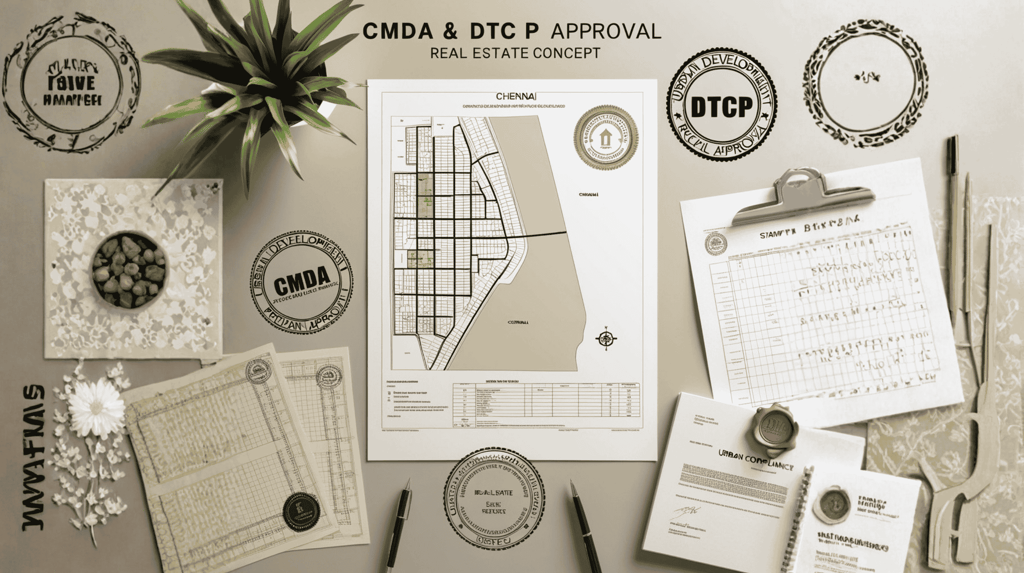
DTCP vs CMDA Chennai explained. Check approvals, legality, fraud risks, map verification steps, and safety rules before buying land in Chennai.`While both regulate land development, they are not the same, and their approval areas differ.
Venshan
12/10/20255 min read
Introduction
Buying plots or flats in Chennai and Tamil Nadu requires a clear understanding of approval authorities. Two names every property buyer encounters are:
DTCP (Directorate of Town and Country Planning)
CMDA (Chennai Metropolitan Development Authority)
While both regulate land development, they are not the same, and their approval areas differ. Confusion between the two leads many buyers to unknowingly purchase unapproved or illegally subdivided plots.
This guide breaks down DTCP vs CMDA, legal rules, approval verification, risks, and exact due diligence steps before buying property.
1. What is CMDA Approval?
CMDA is the planning authority for the Chennai Metropolitan Area (CMA), covering:
Chennai City
Parts of Chengalpattu
Tiruvallur
Kanchipuram
Any construction or land layout in these zones must be approved by CMDA.
CMDA Responsibilities in Chennai Property Approvals
The Chennai Metropolitan Development Authority (CMDA) is the apex planning body responsible for regulating and monitoring urban development within Chennai city limits.
Its core function is to frame and implement the Master Plan for Chennai, ensuring organized expansion, road networks, zoning allocation, and controlled land use.
CMDA is also the authority that issues building plan approvals for residential, commercial, industrial and mixed-use projects, making sure every structure follows planning norms, safety regulations, and development by-laws.
High-rise and multi-storey buildings undergo stricter CMDA scrutiny due to Chennai’s density, traffic impact, fire safety mandates, and structural compliance requirements.
No builder can construct towers or gated townships without CMDA’s formal clearance. Furthermore, CMDA grants layout and subdivision permissions, which means plotted land must receive CMDA approval before it is marketed or sold.
This prevents illegal layouts, encroachments and unplanned expansion. In short, CMDA functions as the legal checkpoint ensuring that land development in Chennai remains safe, compliant, and future-ready.
Where CMDA Approval Is Mandatory
CMDA approval is compulsory in all Chennai Metropolitan limits, covering city zones governed by the master plan.
Any multi-storey apartment project must obtain CMDA clearance along with the respective local body approval to ensure compliance with structural, safety and zoning regulations.
Likewise, large commercial developments such as IT parks, malls and commercial towers fall strictly under CMDA approval due to their scale, impact on traffic, parking norms and urban infrastructure.
In all these cases, CMDA acts as the primary authority for regulating project legality and planning conformity within Chennai.
2. What is DTCP Approval?
DTCP (Directorate of Town & Country Planning) regulates layout approvals outside CMDA limits, covering:
Rural districts of TN
Township expansions
Panchayat limits
Non-metro urban zones
DTCP Regulates
Plot layout approval
Road width standards
Open-space reservation
Public utility allocation (parks, schools)
Where DTCP Approval Applies
CMDA and DTCP serve two distinct planning roles in Tamil Nadu’s property framework, especially around Chennai.
CMDA governs development strictly within the Chennai Metropolitan limits, ensuring that major projects such as multi-storey apartments, commercial complexes, IT parks and township layouts comply with master plans, density control, fire safety and zoning regulations.
DTCP, on the other hand, controls layouts and land developments outside CMDA boundaries, especially in suburban, town expansion and panchayat-governed areas.
While CMDA approvals involve tighter scrutiny due to urban impact and infrastructure load, DTCP focuses on regulated plotting, road access, open space reservation and orderly expansion in developing belts.
Together, both authorities create a dual-layer regulatory system—CMDA securing core city development legality, and DTCP overseeing controlled growth on the outskirts.
3. DTCP vs CMDA: Key Difference Table
The primary distinction between CMDA and DTCP lies in their jurisdiction and enforcement scope. CMDA governs the Chennai Metropolitan Region, where development standards are far stricter due to dense urban planning needs, high-rise safety norms and zoning controls.
DTCP operates across the rest of Tamil Nadu, mainly overseeing plotted layouts and emerging town expansion areas. CMDA approvals are known for very high compliance requirements, applicable to apartments, malls, commercial complexes and large layout developments, whereas DTCP follows moderate approval norms, focusing mostly on plotted layouts.
CMDA also enforces strong inspections, violation penalties and demolition actions, while DTCP maintains moderate enforcement levels in suburban regions.
For builders, CMDA demands mandatory clearance before any construction begins, whereas DTCP requires only layout approval without extensive structural scrutiny. This makes CMDA the stricter urban authority and DTCP the regulatory system for orderly expansion outside the metropolitan zone.
4. CMDA & DTCP Are Not “Land Ownership Approvals”
They approve development legality, not ownership.
Approved ≠ Clear ownership
You must still check:
EC (Encumbrance Certificate)
Title deed history
Patta / Chitta / FMB
Land classification (dry/agri/OSR)
5. 10-Point Fraud-Proof Verification Checklist (DTCP & CMDA Plots)
Use this list before paying token advance, booking amount, or signing sale agreement.
✅ 1. Verify Approval on Official Portal
Check the approval number directly on CMDA / DTCP online records — never trust printed brochures or WhatsApp PDFs.
✅ 2. Demand the Original Approval Order
Ask for CMDA or DTCP signed approval copy with seal, file number, survey numbers and layout sketch.
✅ 3. Cross-Check Survey Numbers
Ensure the plot’s exact survey number appears in the approval document, not just the overall layout.
✅ 4. Check Subdivision Permission
If land has been split further, verify new subdivision approval, not just main layout approval.
✅ 5. Inspect OSR (Open Space Reservation) Allocation
Fraud layouts often sell OSR area as plots. Confirm OSR percentage and location on official map.
✅ 6. Confirm Road Width as Approved
Compare marketed road width with actual CMDA/DTCP map; many layouts shrink roads to create extra plots.
✅ 7. Avoid “Approval Pending / Applied” Claims
Legally, no marketing or selling can be done until final approval is granted.
✅ 8. Check if CMDA Name is Misused
If property is outside metropolitan limits, CMDA label is fake — only DTCP applies.
✅ 9. Validate Title & Patta Status
Ensure seller provides clear parent documents, patta, and no pending encumbrances at SRO.
✅ 10. Hire a Licensed Advocate / Surveyor
Professional verification of title history, FMB sketch, encumbrance certificate & boundary markings prevents long-term legal disputes.
📌 Quick Warning Signals
Only builder map shown, no govt seal
Layout sold via post-dated DTCP promise
CMDA claim for village or panchayat land
Roads in map not visible on site
Patta not matching survey numbers in approval
🔴 "DTCP Application Submitted" ≠ Approved
🔴 "CMDA in progress" ≠ Legal sale
6. How to Verify DTCP & CMDA Approval (Step-by-Step)
Step A: Document Collection
Ask the developer:
CMDA/DTCP Layout Approval Copy
Land ownership records
Layout number & official drawing
OSR allocation
Step B: Government Verification
Check CMDA official portal approvals
DTCP online layout mapping
Cross-check with local body (corporation/municipality)
Step C: Compare Maps
Government approved map vs. developer map
Road widths, OSR area, public access area
Any deviation = illegal subdivision
7. Impact of Buying Plots Without Proper Approvals
Purchasing land without valid CMDA or DTCP approval leads to significant legal and financial risks. Without a sanctioned building approval, the buyer cannot legally construct a house, even if the land is registered in their name.
Banks also refuse housing or construction loans in such cases, as their legal teams reject properties lacking government planning clearance.
Unapproved layouts further face demolition or enforcement action, especially when they fall under violation or encroachment categories flagged by planning authorities.
Over time, these properties lose resale value, as future buyers hesitate to invest in land without compliance documents. Additionally, essential utilities such as electricity, water and sewage connections are routinely denied for unapproved layouts, resulting in long-term living and development challenges.
In effect, skipping approval verification not only increases legal exposure but also erodes asset value and usability.
8. When DTCP Approval Is Not Required. Some lands require no DTCP approval if:
Entire land is already approved previously
Government allotted layout
Land falls under special township authority (But still verify title & encumbrance)
9. Which Approval Is Safer for Buyers?
| If buying inside Chennai Metro | CMDA is the only valid authority |
| If buying in rural Tamil Nadu | DTCP is valid & mandatory |
| For apartments anywhere | Building permit + completion certificate mandatory |
10. Builder/Developer Red Flags
Avoid projects that say:
"Just Panchayat Approval"
"90% DTCP, balance coming soon"
"CMDA exempt because farmland" (false)
FAQs
1. Is CMDA approval better than DTCP?
Not better—only jurisdictionally different. CMDA applies to Chennai; DTCP applies outside it.
2. Can a DTCP-approved plot be sold inside Chennai city?
No. If inside CMDA limits, CMDA approval is mandatory.
3. Can I get a home loan on DTCP plots?
Yes, if:
Layout approval is genuine
Title is clear
Approach road & OSR norms are fulfilled
4. Is Panchayat approval alone valid?
No. Panchayat alone is illegal without DTCP/CMDA.
5. What if the layout has DTCP but not building approval?
Layout approval ≠ building approval. You must separately obtain building sanction.