
Capital Gains Tax on Property Sale in Chennai
Selling property in Chennai can be both exciting and nerve-wracking. While you may be looking forward to a profitable deal, understanding the capital gains tax (CGT) is crucial to avoid unexpected surprises. Many homeowners get confused about how much tax they owe and what exemptions they can claim.
Venshan
12/23/20254 min read
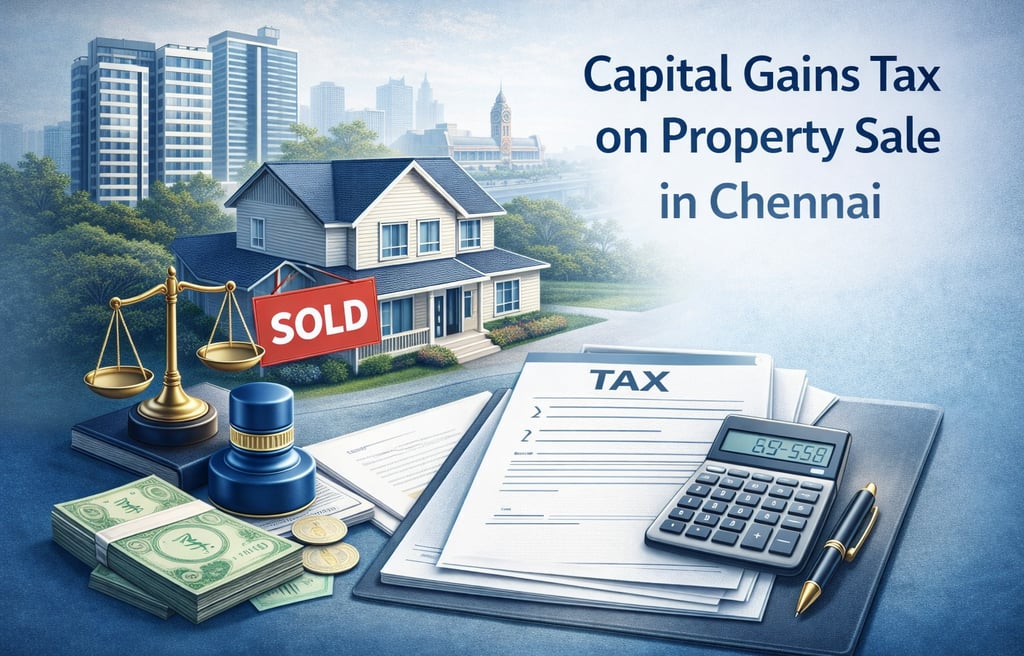
Selling property in Chennai can be both exciting and nerve-wracking. While you may be looking forward to a profitable deal, understanding the capital gains tax (CGT) is crucial to avoid unexpected surprises.
Many homeowners get confused about how much tax they owe and what exemptions they can claim. This guide explains capital gains tax on property sale in Chennai in simple, friendly language so you can plan your sale smartly.
What Is Capital Gains Tax?
Capital Gains Tax (CGT) is a tax levied on the profit earned from selling a capital asset. When it comes to property, the capital asset is your house, apartment, or land.
The tax is calculated on the difference between the selling price and the cost of acquisition (what you originally paid) after adjusting for expenses like renovation, brokerage, or improvements.
Short-Term vs. Long-Term Capital Gains
The holding period of the property determines whether the gains are classified as short-term or long-term.
1. Short-Term Capital Gains (STCG)
Applies if you sell the property within 24 months of purchase (2 years in most cases)
Taxed at your income tax slab rate
Example: If you bought a flat in Chennai for ₹50 lakh and sold it after 18 months for ₹60 lakh, the ₹10 lakh gain is taxed as per your slab.
2. Long-Term Capital Gains (LTCG)
Applies if you sell the property after holding it for more than 24 months
Taxed at 20% with indexation
Indexation adjusts the purchase price to account for inflation, reducing your taxable gain.
💡 Tip: Long-term gains often result in lower tax liability compared to short-term gains.
How to Calculate Capital Gains on Property Sale
Here’s a simple step-by-step method:
Selling Price – The amount you received from the buyer
Cost of Acquisition – Original purchase price
Cost of Improvements – Expenses on renovations or repairs
Expenses on Sale – Brokerage, registration, or legal fees
Formula for LTCG:
LTCG = (Selling Price – Cost of Acquisition – Cost of Improvements – Sale Expenses) after indexation
Example:
Purchase Price (2010): ₹30 lakh
Sale Price (2025): ₹70 lakh
Renovation Cost: ₹5 lakh
Brokerage: ₹2 lakh
After indexation, your taxable gain might reduce to around ₹28 lakh, and 20% LTCG tax will be applied on that.
Exemptions on Capital Gains Tax in Chennai
The Indian Income Tax Act provides certain exemptions that can significantly reduce your tax liability. Some popular ones include:
1. Section 54: Residential Property Exemption
If you sell a residential property and buy another residential house in India within a specified period (1–3 years), you can claim full exemption on LTCG.
Both new construction and purchase of an existing house qualify.
2. Section 54EC: Capital Gains Bond Exemption
Invest your LTCG in specified government bonds (like NHAI or REC) within 6 months
Maximum investment limit: ₹50 lakh
Exemption applies up to the invested amount
3. Section 54F: Sale of Any Asset to Buy Residential Property
If you sell any asset other than a residential house and invest the proceeds in a new residential house, you may claim LTCG exemption.
💡 Tip: Always plan the investment carefully to avail maximum exemption.
Stamp Duty and Registration Charges in Chennai
While CGT is separate, selling property in Chennai involves stamp duty and registration fees, which can be added to your cost of sale to reduce capital gains:
Stamp Duty: ~7% to 8% of the property value
Registration Charges: ~1% of property value
Brokerage Fees: 1% to 2% of sale price
Including these in your calculations helps lower your taxable capital gains.
Tax Deduction at Source (TDS) for Property Sale
From 2013 onwards, the buyer must deduct TDS if the sale consideration exceeds ₹50 lakh:
Rate: 1% of total sale price
Responsibility: Paid by the buyer, but can be adjusted against your final tax liability
PAN Required: Both buyer and seller must provide PAN
💡 Make sure to obtain TDS certificate (Form 26QB) to avoid double taxation.
How NRIs Are Taxed on Property Sale in Chennai
Non-Resident Indians (NRIs) selling property in Chennai are subject to the same capital gains tax rules, with a few additional points:
Buyer must deduct TDS at 20% (LTCG) or as per slab rate (STCG)
Exemptions like Section 54, 54EC, and 54F apply
Indexation benefit is also available for long-term gains.
Common Mistakes to Avoid When Calculating Capital Gains
Many homeowners make avoidable mistakes that increase their tax liability:
❌ Ignoring indexation benefits
❌ Not including renovation or sale expenses
❌ Forgetting TDS deducted by the buyer
❌ Missing exemptions under Sections 54, 54EC, or 54F
❌ Misreporting in income tax return
✅ Always keep proper documents and consult a tax professional before filing returns.
Filing Capital Gains in Income Tax Return
You must report capital gains in ITR forms:
STCG: Add to total income under Income from Other Sources
LTCG: Report under Capital Gains (Schedule CG)
Claim deductions and exemptions
Pay remaining tax (if any) before filing return.
Planning Tips for Homeowners in Chennai
Plan the Sale Strategically
Consider selling after 24 months for LTCG benefits.
Use Exemptions Wisely
Buy a new house or invest in 54EC bonds to save tax.
Keep All Bills & Documents
Renovation, brokerage, stamp duty, registration receipts
Consult a Tax Advisor
Avoid mistakes and plan investments for maximum exemption
Quick Example of Tax Savings
Imagine selling a Chennai property for ₹1 crore after 5 years:
Purchase Price (Indexed): ₹60 lakh
Sale Expenses & Renovation: ₹5 lakh
LTCG Taxable Amount: ₹35 lakh
20% Tax = ₹7 lakh
If you invest ₹35 lakh in a new house or 54EC bonds, LTCG tax can be fully exempted, saving you ₹7 lakh legally!
Key Takeaways
Capital Gains Tax is on profit, not sale price
Holding period matters: Short-term vs. Long-term
Exemptions exist under Sections 54, 54EC, and 54F
Include all eligible expenses to reduce gains
TDS and income tax filing are mandatory
Plan sale strategically for maximum tax savings
Selling property in Chennai doesn’t have to be stressful. With a little planning, proper documentation, and understanding of capital gains tax rules, you can save thousands and enjoy a smooth transaction.